
375th Anniversary

The Sisters of St. Joseph of Carondelet join with our fellow Sisters of St. Joseph congregations in celebrating the 375th anniversary of our founding.
In 1650, six ordinary women, under the guidance of Jean-Pierre Médaille, SJ, joined together in community under the patronage of St. Joseph in Le Puy-en-Velay, France. These six women had a common desire to grow in their love of God and serve the unmet needs of the people around them, whom they came to call their “dear neighbors.” From their humble beginnings in a small kitchen, the order grew to include communities all over the world.
As a part of our 375th Jubilee Anniversary Celebration, we’ve asked our sisters and charism partners to write blog posts reflecting on integral parts of our history and spirituality, illuminating how these symbols and traditions continue to shape our present and future.
Women Called to Serve the Dear Neighbor
Apostolic Foundations
When the “Little Design” of Father Jean-Pierre Médaille, SJ began to take shape in the mid-1600s, there was only one form of religious life available to women: the cloister. Groups of women had tried to create apostolic congregations, focused on ministry and service to the people of God, but they had been shut down or shut behind the doors of a convent.
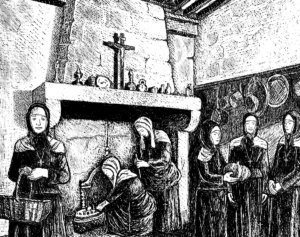
Building the foundations of what would become the Sisters of St. Joseph, Father Médaille carefully described a new community of women in service of the dear neighbor. These women had no monastery but lived together in a “common life.” The Règlements instructed the women to leave their house only “to go to the churches, to visit the sick, hospitals, prisons, and to perform other exercises of charity.” This strict sounding rule left a loophole wide enough for the women to address any and every need. Many chose to wear widow’s black so that they could move about in public unaccompanied and minister to the poor.
Finally, in 1650, six women of the “Little Design” joined together in community under the patronage of St. Joseph in Le Puy-en-Velay, France. Offering their lives in service to God and the dear neighbor, this religious community devoted themselves to the needs of ordinary people, living among them.
Ministries of the First Sisters
Free to minister outside the walls of their common home, the original Sisters of St. Joseph were encouraged by Father Jean-Pierre Médaille to “practice all the spiritual and corporal works of mercy of which women are capable and that will most benefit the dear neighbor.”
Our foundresses set out to “divide the city, seek out its ills and cure them.” Each sister claimed went to different sections of the city where they found out the needs of the dear neighbor from the people themselves.

During the beginnings of the congregation in France, our sisters were already providing educations, helping women become self-sufficient, taking care of the orphaned, running hospitals and more.
Capable of Anything
Since our founding, the Sisters of St. Joseph have traveled to different cities, nations and continents. In each new place, our sisters “seek out its ills and cure them.” As the needs of the dear neighbor grew and changed, our sister adapted to meet them. Father Jean-Pierre Médaille told our first sisters to do “anything of which a woman is capable.” From our history and ever-growing legacy, we know women are capable of doing anything.
Sisters of St. Joseph Now
Today, Sisters of St. Joseph can be found in soup kitchens, shelters, universities, schools, hospitals, courtrooms, prisons, retreat centers, offices, nursing homes, laboratories, studios and hospices. We are educators, lawyers, doctors, nurses, family therapists, social workers, patient advocates, spiritual directors, parish ministers, theologians, psychologists, physical therapists, administrators, artists, authors, musicians, poets and more. We continue to serve the dear neighbor, doing anything of which we are capable.


we are very proud of the whole congregation from up here in Ontario CANADA.
You have lived a great example for all of us to follow in our daily lives. Bless you all.
Janet